


If Mark Zuckerberg had launched Facebook from the Caribbean, it is unlikely the company would have become the trillion-dollar global platform it is today.
The company, now known as Meta Platforms, employs 80,000 people and operates at a scale few companies ever reach. That success was not simply the result of one entrepreneur’s vision. It was made possible by a mature innovation ecosystem in the United States (particularly in Silicon Valley) where entrepreneurs benefit from venture capital networks, world-class universities, research institutions and global market access.
Across the Caribbean, entrepreneurs launch new businesses every year driven by creativity, resilience and ambition. Yet very few grow into globally competitive firms. The common explanation is the myth that our entrepreneurs lack ambition, discipline or access to capital. While these factors may influence individual outcomes, they do not explain the broader pattern.
The real issue is structural. Most Caribbean countries operate without a fully developed innovation and entrepreneurial ecosystem capable of supporting companies as they attempt to scale.
Missing ecosystem
Successful innovation economies are not built by entrepreneurs alone. They are supported by coordinated ecosystems that allow ideas to move from research and development to commercialisation and eventually to global markets.
These ecosystems include universities, research institutions, venture capital networks, incubators, accelerators, export development programmes, supportive regulatory frameworks and strong collaboration between government, industry, academia and civil society.
The persistent myth of the “lone innovator” has often led to misguided policy choices in the Caribbean. Rather than building the institutional architecture required for innovation-driven growth, many countries have relied on fragmented programmes and short-term initiatives.
Structural gap
Only one Caribbean country, Jamaica, has adopted a formal national innovation policy. Only the Dominican Republic has established a parliamentary committee dedicated to science, technology, innovation and research. None have a national innovation agency with the mandate to strategicallymanage and coordinate the development of the ecosystem itself.
Global innovation research
The importance of ecosystems is reinforced in the WIPO Innovation Capabilities Outlook 2026, which concludes that innovation success depends not only on the strength of individual actors but on how science, technology, entrepreneurship and production interact as a system.
The report highlights a persistent challenge across Latin America and the Caribbean, which is the difficulty of translating research and technical capabilities into entrepreneurial ventures and technological breakthroughs.
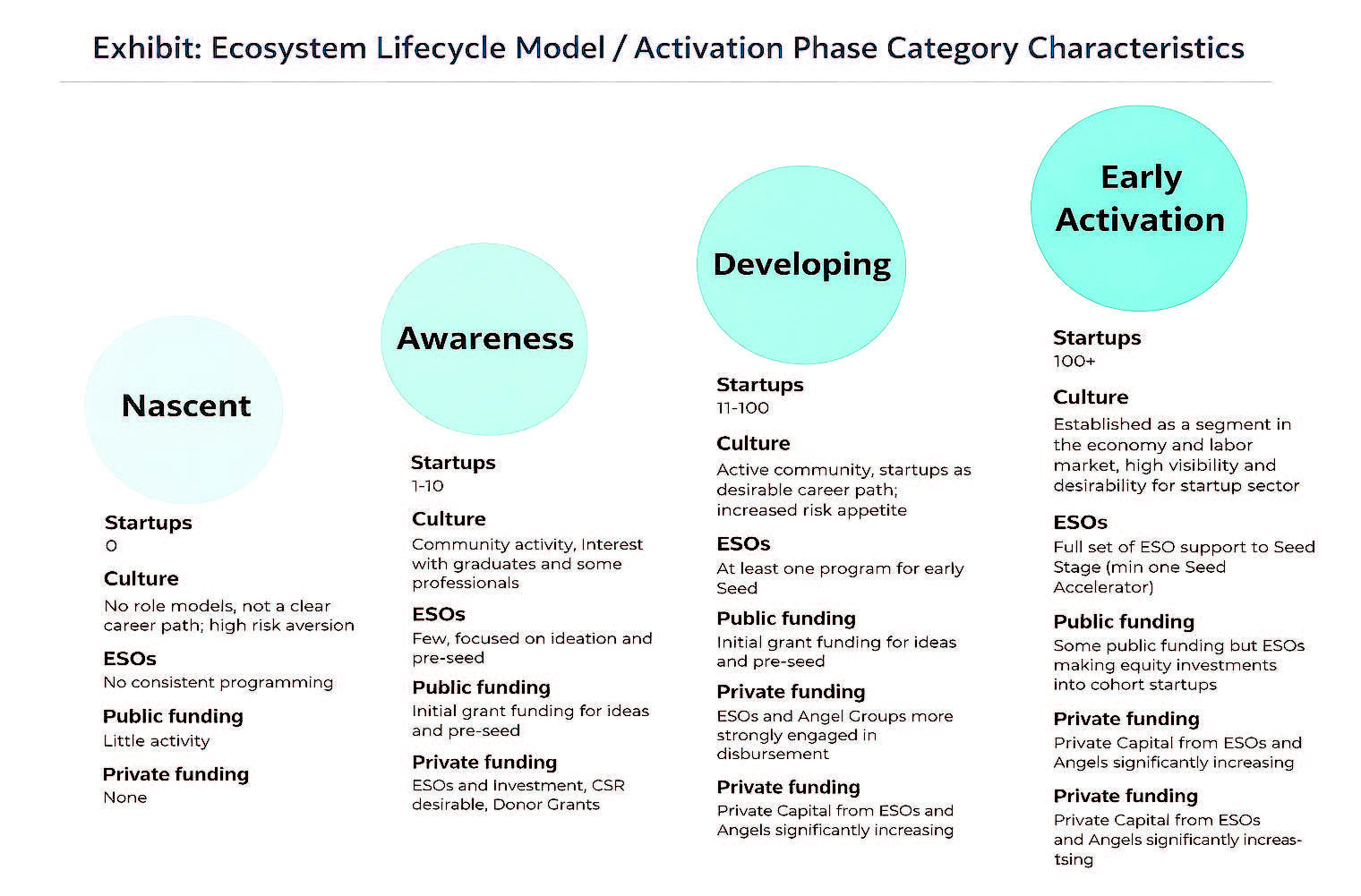
A recent regional assessment provides further evidence. The CARIBEquity Caribbean Innovation Ecosystem Assessment evaluated innovation ecosystems in 15 Caribbean countries guided by the methodology developed by Startup Genome.
The findings are sobering. Every Caribbean ecosystem falls within the lowest stage of development, known as the Activation Phase.
Even within that phase, none have reached the highest sub-level known as Early Activation.
Only four countries Trinidad and Tobago, Jamaica, Barbados and the Dominican Republic, reach the third sub-level known as the developing category. Notably, these are also the only Caribbean countries listed on the Global Innovation Index.
Three countries are at the second sub-level (awareness category) and the majority (eight of the 15 nations) are at the very beginning of their ecosystem development lifecycle known as the nascent category. Overall, the region’s innovation and entrepreneurial ecosystem remains fragmented and underdeveloped.
Technological crossroads
The weakness of the region’s innovation ecosystems is particularly concerning at a time of rapid technological transformation.
The world is in what is widely described as the Fourth Indus-trial Revolution, where frontier technologies such as Artificial Intelligence and Quantum Computing are reshaping industries, redefining global competitiveness and restructuring the global world order. No wonder, Accenture’s Global Disruptive Index jumped from 4 per cent to 200 per cent and may now be at 1,000 per cent.
High-growth companies emerging from innovation ecosystems are a critical source of job creation, productivity growth and economic diversification. Moreover, the 2025 Nobel prize for economics science proves that technological innovation is the true engine of economic growth.
Globally, start-up ecosystems now generate more than US$3 trillion in economic value annually, which is more than five times the combined GDP of all Caribbean economies.
Countries that consistently produce globally competitive companies do so because they have deliberately invested in building these ecosystems.
Managing innovation
Recognising this, international institutions have begun developing formal governance frameworks to help organisations and countries manage innovation more systematically.
One example is the ISO 56001 Innovation Management System Standard, developed by the International Organisation for Standardisation (ISO). The standard provides organisations with a structured framework for governing innovation through leadership accountability, strategy alignment, processes and performance measurement.
The international community is now going a step further with the forthcoming ISO 56012 Innovation Ecosystem Management Guidelines, which will provide guidance for establishing, managing and continually improving innovation ecosystems themselves.
Together, these frameworks reflect a growing global recognition that innovation is not accidental.
It is the result of systems that are intentionally designed, coordinated and managed.
Rare success story
There are occasional success stories. One example is Trinidadian entrepreneur Aldwyn Wayne, founder of the fintech company WiPay, which now operates across the Caribbean, Latin America, West Africa and the United States.
However, producing one scale-up every few years is not evidence of a healthy innovation system. By comparison, Singapore produced more than 4,500 active technology start-ups in 2025 alone and has generated over twenty unicorn companies valued at more than US$1 billion.
Guyana’s strategic bet
One country that may reshape the regional conversation is Guyana.
Although its innovation ecosystem currently ranks among the least developed in the region, the country has become one of the world’s fastest-growing economies in recent years due to the commodities of oil and gas.
However, President Mohamed Irfaan Ali has repeatedly warned about the risks of over-reliance on natural resources and the dangers of the Dutch Disease. He insists that Guyana’s future lies in its people and their capacity to innovate.
In response, Guyana has begun investing in long-term innovation infrastructure, including the development of Silica City, envisioned as Caricom’s first fully sustainable and technologically advanced city. Innovation districts will be located in the heart of the city, which will house leading institutions and businesses that will converge with start-ups, fostering creativity and collaboration in compact, accessible, and technologically advanced spaces for living, working, and shopping.
The government is also actively engaging its diaspora, including figures such as artificial intelligence researcher and entrepreneur Jason Mars, co-founder of the AI company Clinc, a leading AI company that created one of the world’s most sophisticated conversational AI platforms.
From individual effort
Innovation that depends solely on individual entrepreneurs will always remain fragile.
Innovation that focuses only on adopting the latest technologies, whether artificial intelligence or any other frontier technology, will also fail if it is not embedded within a system defined by governance, leadership accountability, processes and measurement.
Without these foundations, innovation becomes theatre rather than transformation. Encouraging entrepreneurship is important.
But celebrating entrepreneurship alone will not produce globally competitive firms. Entrepreneurs can only scale when the surrounding ecosystem provides the structures necessary for innovation, commercialisation and international expansion.
The Caribbean does not lack entrepreneurs. What it lacks are the ecosystems required for their success.
Emerson John-Charles is the chair, Innovation Association of Trinidad and Tobago and an ISO National Innovation Expert.